



The story of Accra’s property market in the first half of 2026 is ultimately a story about recovery earning its credibility. After two bruising years of inflation shocks, cedi depreciation, and frozen buyer confidence, the fundamentals have quietly shifted. This isn’t a boom, not yet, but it is a market that is beginning to reward those who show up prepared.
Here is what the data and the ground-level picture actually say as we cross the midpoint of the year.
The Macro Backdrop: Why This Moment Is Different
Any honest assessment of the Accra property market has to start with Ghana’s broader economy, because that is what drove the pain of 2023–2024 and what is now driving the cautious optimism of 2026.
Ghana’s real estate market entered 2025 at a critical inflection point following a period of macroeconomic instability marked by high inflation, currency depreciation, and elevated interest rates. But recent economic indicators from the last quarter suggested a significant recovery was underway, with falling inflation, easing monetary policy, and renewed investor confidence pointing toward broad-based growth across residential, commercial, and mixed-use segments in 2026.
The single most consequential development for buyers has been movement on interest rates. The Bank of Ghana cut its policy rate to 18% by the end of 2025 a 10-point reduction which is slowly opening doors to mortgage financing.
On the construction cost side, the relief is just as significant. Ghana’s Prime Building Cost Index hit 3.9% year-on-year in January 2026, its lowest reading in years and down sharply from 23.7% in January 2025, the ninth consecutive month of declining construction cost inflation. Labour cost growth also fell to 5.4% year-on-year. For developers, that means more viable project economics. For buyers, it means new supply coming to market at more sustainable price points.
Price Performance: What’s Actually Growing
The forecasted price movement for Accra over the next 12 months is modest appreciation of around 5% to 8% in nominal terms for well-located properties, with prime areas potentially reaching the higher end and fringe areas seeing flat or slower growth.
But the headline number masks a wide spread. Not all of Accra is moving together.
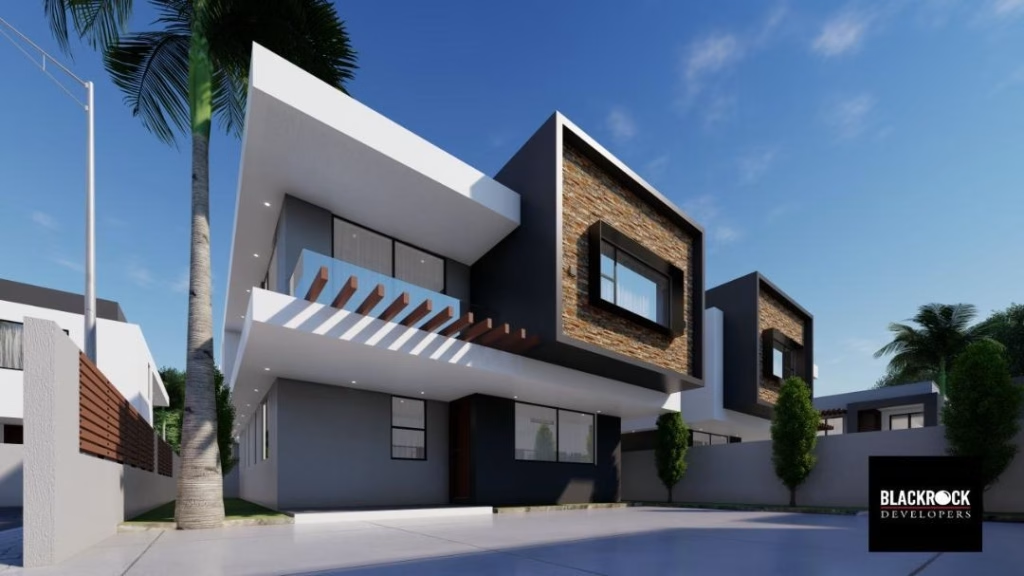
Mid-market townhouses and gated community homes are the strongest performers, with some clusters recording double-digit annualised price growth in cedi terms. Luxury apartments in prime Accra enclaves, on the other hand, remain sluggish oversupply and a limited buyer pool are pushing selling times past six months in many cases.
This is the clearest signal the market is sending right now: it’s rewarding value, not prestige alone.
The Neighbourhoods Moving Fastest
Geography matters enormously in 2026. The areas generating the most activity share common traits, improved road access, new gated estate developments, and price points that the middle-class buyer can actually reach.
Expansion corridors such as Adenta, Oyarifa, Pokuase, and Oyibi are seeing the fastest price growth in Ghana, driven by new gated developments and improved road access. Annual price growth in these neighbourhoods is running between 12% and 18% in cedi terms, significantly outpacing the 7% to 10% average for Greater Accra overall. The main demand driver is that these areas have crossed the threshold from “too far to commute” to “actually livable,” thanks to interchange projects and gated communities that offer the security and utilities middle-class buyers want.
In western Accra, the story is similar. The Weija-Gbawe corridor is emerging as one of the market’s most compelling investment plays, driven by improved road infrastructure, proximity to West Hills Mall, and lower entry prices relative to central Accra.
For buyers who missed East Legon and Cantonments a decade ago, these corridors are the closest analogue available today.
What Investors Need to Know About Returns
The rental market is providing a meaningful floor under investor confidence. Rental yields in Accra remain attractive, with gross yields around 8% to 11% in areas like central Accra and East Legon. Renter demand appears to be growing faster than quality rental supply in most districts new rental completions remain constrained by permitting delays, infrastructure gaps, and financing challenges.
For those looking at total return potential, investors in 2026 are seeing total annual returns rental income plus appreciation ranging between 12% and 18% in select corridors. The Accra real estate market is maturing, shifting from speculative volatility to a stable, high-growth environment.
Diaspora buyers are increasingly a driving force. Foreign direct investment in Ghanaian real estate surged 18% in 2024, with foreign investors accounting for nearly 30% of high-end property purchases in Accra a primary reason prime Accra valuations have remained firm even through Ghana’s period of economic difficulty.
The Demand Side: Who Is Buying, and Why Now
Ghana still faces over a million-unit housing shortfall, while a chronic under-supply of social and mid-end housing contrasts with a relative oversupply of luxury stock. Rapid urbanisation, population growth, and rural-urban drift continue to fuel housing demand, especially within Greater Accra.
The continued Bank of Ghana rate cuts, combined with renewed diaspora investment activity, represent the single biggest demand-side trigger that could drive Accra prices higher — many Ghanaians abroad have been waiting for macro stability before buying property back home, and that window appears to be opening.
What Buyers Should Watch Out For
The market’s recovery doesn’t mean the risks have disappeared. A few realities every buyer should factor in:
Nominal vs. real gains. Much of the nominal price increase seen over the past 12 months reflects general price inflation and rising construction costs rather than true real estate appreciation, which means the market can feel expensive even if real values are relatively flat.
Title and documentation still matter more than anything. This is not a boom market. It is a market that rewards quality assets, realistic pricing, and clean documentation. Speculators will find it difficult; patient, well-positioned buyers will find genuine opportunities.
Days on market. The estimated average days-on-market for residential properties is roughly 90 to 150 days. Well-priced homes in popular neighbourhoods can sell in 45 to 90 days, while overpriced listings or those with unclear land titles can sit considerably longer.
Currency risk remains real. The single factor posing the greatest structural risk is currency volatility — a sharp cedi depreciation would immediately spike imported material costs and reprice the entire market upward in cedi terms while squeezing affordability.
The Mid-Year Verdict
Ghana’s real estate market is not without its complexities. But the data consistently points in one direction: a market that has worked through its most difficult period and is now positioned for stable, credible growth.
For the end-user buyer, the professional or young family looking for their first or second home, mid-market gated communities in the growth corridors offer the strongest combination of livability and long-term value. For the investor, rental yields remain attractive and total return projections are compelling in the right locations.
The window isn’t unlimited. As infrastructure matures and diaspora capital returns at scale, today’s “emerging” neighbourhoods won’t carry that label for long.
For enquiries about available units at The Cove @ Haatso, contact our sales team
